SEO Traffic Forecasting with Google Search Console Data
SEO Traffic Forecasting is the analytical process of projecting a website’s future organic performance metrics (clicks, impressions) based on historical data patterns. Forecasting helps establish Key Performance Indicators (KPIs) from recent traffic trends.
The Data Reliability Problem
Most forecasting efforts fail due to poor data inputs. Relying on third-party search volume estimates introduces significant margins of error, as these tools lack access to your website’s actual, historical performance data and specific CTR metrics. Standard GSC, conversely, is strictly retrospective and offers no native predictive capabilities.
Algorithmic Forecasting with First-Party Data
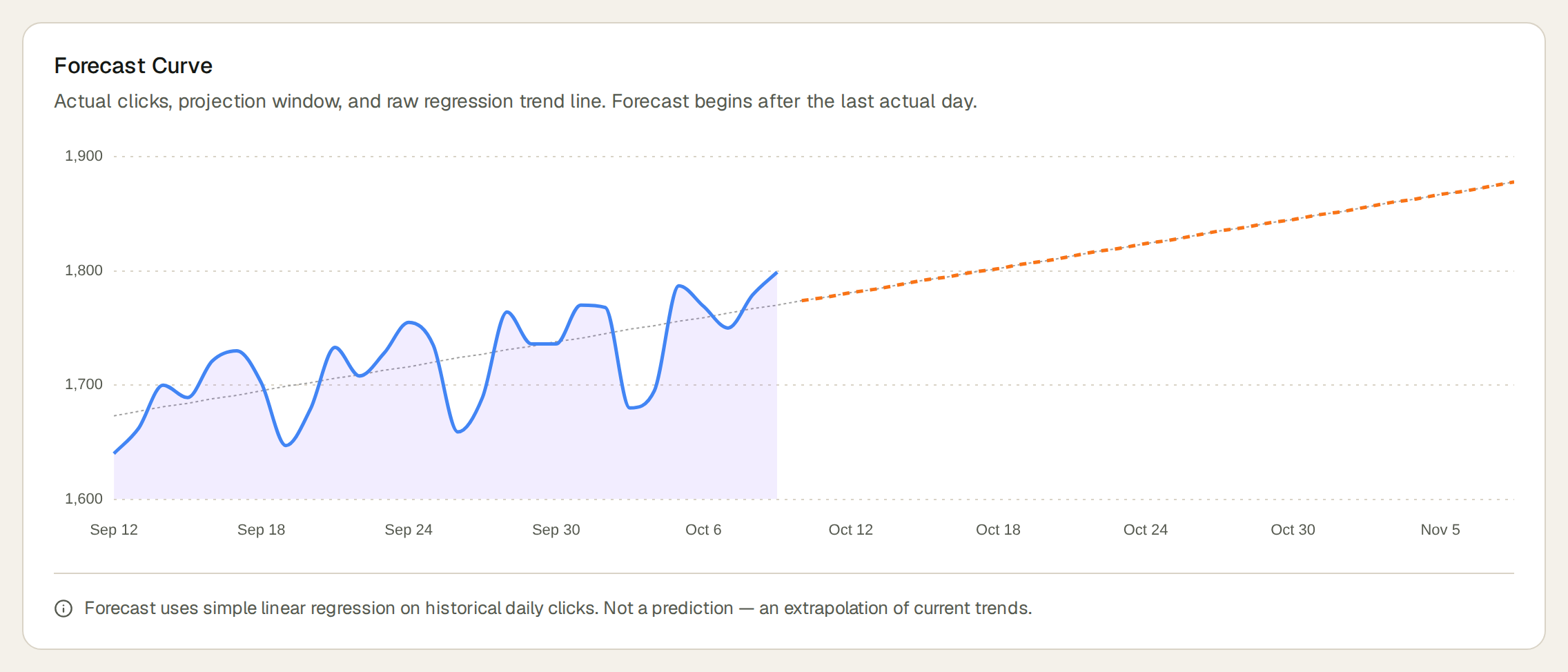
Kong Metrics fits a linear trend to your historical daily clicks to project the next 30 days.
1. A Trend Line, Not a Seasonal Model
The forecast fits a linear trend to the daily clicks in your chosen date range (28 days by default, at least 7) and projects it 30 days ahead. It extrapolates the current trend and does not model seasonality, so compare the same months in your stored history before you plan for a seasonal peak.
2. Historical Trend Trajectory
The forecasting model accounts for your domain’s recent growth velocity.
3. KPI Benchmarking and Variance Analysis
Forecasts provide a vital baseline for variance analysis. By comparing your projected BAU trajectory against aggressive organizational targets, you can quantify the exact traffic gap that needs to be bridged, allowing for more accurate resource allocation and budget planning.
Data-Backed Strategic Planning
Replace speculative goal-setting with a trend line drawn from your own data. Kong Metrics gives SEO teams a data-backed baseline to align organic search strategy with broader business objectives and stakeholder expectations.